El Encanto Restaurant in Cave Creek
For years when out of town guests would visit I would take them shopping and out for lunch at the original El Encanto in the heart of Cave Creek. The children especially loved sit along the water of the picturesque pond with the playful wildlife, including ducks, and turtles. The adults enjoyed dining in a romantic Old-World Mission-style restaurant with a great menu and cocktails! They say the menu is authentic handmade Mexican Cuisine, with specialties from regions all over Mexico, including daily fresh fish specials. “All of the Mexican Cuisine at El Encanto is authentic and handmade, from the freshest ingredients, and is considered by many to be the best Mexican food in the Valley.”
They serve Breakfast from 8am till noon Saturday and Sunday. They make wonderful Frittatas of Three cheese (cheddar, monterey jack and Jalapeno Jack) $6.20 or Ham, mushroom, onion and swiss $7.10 or Chicken, avocado, and swiss $6.75 or my favorite Avocado, monterey jack and roasted green chilies $6.50 or also good Fresh spinach, mushroom, onion and swiss $6.50.
Lunch is served 11 am to 3pm everyday and includes all of your usual Mexican food fare, well made and reasonably priced. You can get combo plates with rice and beans or A la carte.
The Shredded beef taco, cheese enchilada and beans $7.45. Cheese enchilada, rice and beans $6.95. Chile relleno, rice and beans $6.95. Chicken enchilada with rice, beans and sour cream $7.55 Taco salad, topped with beef or chicken $5.75. Or the Folded quesadilla "El Encanto" with chicken or shredded beef $6.85. There are many many more selections. The Seafood enchilada with green chili sauce and a dollop of fundido sauce. Served with rice. $6.95 is especially nice as is the Grilled sea bass, served with rice and flour tortilla $6.85.
El Encanto A la Carte Chimichangas of Chicken, of shredded or machaca beef, green chili beef or vegetables $7.15 or Seafood $7.30 all wonderful. Burros, Flautas, Tacos, Enchiladas, Rellenos, Tamales, or Tostadas, offer no better way to warm up on a cold winter day!
At dinner you may want to try Especiales DE El Encanto which include the most special Rellenos of Ancho Chile Relleno, fresh roasted Anaheim chile stuffed with mesquite grilled chicken breast and beans, covered with a savory ancho chile sauce and Monterey Jack cheese served with black beans and rice $15.75. If you are daring you will want to try Carnitas Poblano Relleno, a large fresh roasted Poblano chile stuffed with tender pork carnitas and topped with green chile sauce and jack cheese served with black beans and corn rice $15.75. Chile Relleno or Chile Relleno Con Carne or Pollo Fundido are great too. From The Mesquite Grill try the Sizzling Hot Fajitas marinated strips of chicken, beef, pork or vegetables, mesquite grilled with fresh peppers and onions served sizzling hot at your table with warm tortillas, beans, guacamole and pico de gallo salsa $14.65 Shrimp $16.95 – a bargain when compared to fajitas elsewhere. And it creates and exciting atmosphere when that sizzling skillet appears!
Mole is a blend of red chiles, sweet dark chocolate, a hint of roasted nuts and spices. If you like mole, you will love El Encanto’s mole. Steak, chicken, fresh Sea Bass or Guaymas Shrimp, are served in several ways and all are delicious.
El Encanto recently opened its second restaurant, El Encanto Dos, in Desert Hills Arizona. Their website says, ”The new restaurant has the same great food in a different setting. It also has the feel of Mexico with vibrant colors, tile scenes and wrought iron accents. There is plenty of outdoor dining next to a small creek, where guests sit next to a picturesque fireplace and enjoy their meals.””Both restaurants have uniquely designed indoor/outdoor Cantinas with views of the enchanting setting. Intricate handcrafted details include a bar top made of swirlstone; inlaid Mexican tile; and handmade wrought iron wine racks and chairs designed by local artists. El Encanto Dos also boasts a sports bar with 5 large plasma televisions.””The cantinas carry more than 40 different tequilas that can be sampled in flights, and a distinctive wine selection from Mexico, Spain, South America, California and Oregon. The Cantina Tapas menu offers a selection of smaller, more specialized items to the bar clientele.” ”The owners, Bill Nelson and his daughter Christine, have tried to create an authentic Mexican atmosphere in which to enjoy similarly authentic and in many cases unique to Arizona Mexican specialties. “
In the many years of dining at El Encanto, I have experienced many varied levels of service. But I must say they have always been warm and friendly and have done their best to make it a good meal. At times it’s crowded and busy and the noise level can get up there on those raucous occasions. But I’ve never been unsatisfied with the food and continue to return frequently. I guess you can say they have earned an endorsement as a favorite place by the Cowgirl Connoisseur and you can tell them so the next time you dine at El Encanto Restaurant in Cave Creek. Phone: (480) 488-1752 at 6248 E. Cave Creek Rd. Cave Creek, AZ 85331 or the new El Encanto Dos Restaurant in Desert Hills Phone: (623) 780-5948 at 1112 E Carefree Hwy Desert Hills, AZ 85085. Hours 11am-10pm weekends 8am-10pm at both locations. http://www.elencantorestaurant.com/
Wednesday, January 24, 2007


The Horny Toad Restaurant Cave Creek
When out of town relations arrive from all corners of the world, it’s time to treat them to one of the unique Arizona dining experiences. The Horny Toad in Cave Creek provides an entertaining and humorous adventure.
What's a horny toad? According to their website at http://www.thehornytoad.com/ “(Somebody always gets in a nasty chuckle). Maybe to easterners, it's a frog anxiously awaiting an answer to a mating call. Some other innocent soul might visualize a frog with spikes. Well, they are answers, however wrong, but a man named Webster put in a lot of research and when he publicized his book telling what things meant, he came up with "...any of several, small, scaly insect-eating lizards of the family Iguanidae, genus Phrynosoma, whose body somewhat resembles that of a toad or frog. The body is rough, the tail short, the head furnished with horny spikes. Several species inhabit the arid plains of the southwest U.S...." We named our restaurant after this much-maligned desert dweller after hearing the Truly Forgettable Saga of the Horny Toad. Sometime during the last century, an old prospector working the area a few miles northeast of the little town of Phoenix, Arizona, came upon a small watering hole. He thought to himself that this here was mighty purty scenery and he'd bet them easterners would give an arm and a leg for some of this property. They could build them some roads and put up funny names on the street signs and everybody'd be carefree, even if they had to live in caves and drink from the creek. Unpacking his burro, he ate the wrapped tortilla prepared by the Mexican cook back in Phoenix before he unloaded his donkey. As he sat stirring the campfire, he noticed the ruckus the frogs over on the other side of the pond made with their mating calls. They sure sound anxious, he thought to himself. His aching feet reminded him not to buy any more of those 2 for $5.00 boots. As he eased the boots off to soak his tired feet, he saw the many calluses they had given him and he said to himself, I sure am getting horny toed.”
Okay if that story doesn’t convince you maybe the menu will do the trick! Prices vary from time to time. Lunch prices range from $5.25 to $12.95. Dinner prices range from $7.95 to $24.95. Don’t expect anything fancy or frilly. It’s just good old plain western style BBQ and café fare.
Taco Salad (Beef or Chicken), Chef’s Salad, Horny Toad Chicken Salad, Caesar Salad or Chicken Caesar or a Vegetarian Plate all served with pretty darn good “Homemade Dressings” including Blue Cheese, Ranch, Eye-talian, Honey Sesame, and 999 Island. All Salad Dressings & BBQ Sauce can be purchased for Take-Out.
Their list of “OTHER STUFF” includes Soup de Joor, (don’t know if that’s the same as de Jour), Tacos, Cheese Crisp, Hot Wings or BBQ Wings, Saute' o' Mushrooms, Jalapeno Poppers, and their own award winning recipe Chili. And try the Onion Rings, Basket of Fries, Deep Fried Zucchini or Mushrooms, Garlic Bread, Baked Spud, or Cowboy Beans.
For an entrée you might enjoy BBQ Beef Ribs with all you can eat on Monday Nite! They are tender and tasty and you’ll want to bring a big appetite. BBQ Baby Back Pork Ribs, BBQ 1/2 Chicken, their “Famous Fried Chicken”, Pork Chops, Carne Asada, Deep Fried Icelandic Cod with all you can eat on Fridays! Or try Broiled Icelandic Cod, Camarones, Steak & Camarones, Choice Mexican Shrimp, Fajitas, 16 oz. Porterhouse Steak, 12 oz. New York Strip Steak, 8 oz. TOP Sirloin Steak, 12 oz. Ribeye, Toad Cut Prime Rib, Toadette Cut Prime Rib, Mesquite Grilled Salmon or Homemade Meatloaf.
Their Mesquite-cooked 1/2 lb Burgers are great with selections including Horny Toad Burger, Tiajuana Torpedo and Patty Melt as well as a standard burger.
For lunch you might enjoy a sandwich of BBQ Pork, BBQ Beef, BBQ Chicken Sandwich, or a Fish Sandwich. They also have Ham Bun, Grilled Cheddar Cheese, Grilled Ham & Cheese, French Dip, Reuben, Cold Turkey, B.L.T. and B.L.T.C.T. (cheese & turkey).
They also have a children’s menu and great desserts.
So far I haven’t made many comments about the food beyond listing the options and they are many. Over the last decade I have sampled almost everything on the menu above and have enjoyed every single bite. I can’t say I have ever walked away unsatisfied from any meal and there have been many at the Horny Toad. I haven’t commented about the preparation because there is straight forward and delicious. You won’t find unusual or exotic items, just good food well prepared and served happily!
When looking for a place to take the relatives while sightseeing, drop by the Horny Toad and treat them to a Cave Creek legend. And tell them the Cowgirl Connoisseur sent you. 6738 E. Cave Creek Road, Cave Creek, Arizona 85331 Phone: 480-488-9542, Fax: 480-488-3270, E-Mail: info@thehornytoad.com.
Deer Valley Cheerleaders headed to National Championships
Deer Valley Cheerleaders headed to National Championships
The world could use more cheerleaders. They’re the ones out in front always smiling and encouraging the rest of us to be positive, to be excited, to be more involved.
Cheerleading is hard work. The hardest part is the commitment to practice every morning at 5am three hours a day, all year long. No time off in the summer. The program is demanding.
Deer Valley Coach Vicki Jones demands her cheerleaders have excellent attendance, good grades, incredible attitude and time management skills to stay on the team. Training includes tumbling, gymnastics and running for endurance. All of that sweat and aches for what? The payoff is to be the best, to compete at a national level, and to do it all with your closest friends.
Camaraderie is what motivates sixteen Deer Valley Cheerleaders age 14-18 who will be headed to the UCA (Universal Cheer Association) National Championship competition in Orlando Florida in February. It will be televised on ESPN. Deer Valley won 1st place at the Regional UCA Competition back in November which qualified them for the UCA Nationals.
“We are competing against east coast teams and it’s a really tough competition. The west coast teams hardly ever make it into the top ten,” says Jones. “The west coast style is more performance oriented, where the east coast style is more crowd oriented. So we’re taking a routine this year that is a more crowd oriented performance.”
Cheerleader senior Mercedes Camarillo says, “It’s a lot of hard work to win. The teams are really competitive. Coach Jones keeps us very disciplined. She’s hard on us but it’s worth it because she knows what it takes to win.”
Jones knows the competition. “It will have to be a flawless routine to succeed in Orlando. I have some girls who went last year and know what to expect and that’s helpful. We started working last June and some girls came in not being able to do much. By this time of year they are amazed about what they can do.”
Deer Valley Cheerleaders will also be going to UCA competition in Anaheim this March. They work hard at fundraising by selling candy and holding bake sales, anything they can to cover the trip expenses. Training, fundraising and travel builds strong bonds between the girls.
“We are all really close because we spend so much time together,” Camarillo comments. “We’re like a family.”
An opportunity to see the Deer Valley Cheerleaders in action is coming up soon when Glendale’s Jobing.com Arena will host the Arizona Interscholastic Association 2007 AIA State Spirit Line Championships competition on January 20th. It’s a huge competition including anyone who has qualified at a regional. “Deer Valley Cheerleaders will compete in Pom, Show and Stunt categories. For the last 3 years we have won 1st in the Show division,” says Jones.
Admission is $8 for adults and $6 for students with proper ID. Tickets are available the day of the competition beginning at 7:30am. The doors will open for the spectators at 7:30am and the competition will begin at 8:30am. A performance timeline will be online at www.aiaonline.org under "Activities" and "Spirit Lines" beginning Jan. 12.
Assistant Coaches Crystal Tuscano and Amy Coughanor will travel with the team and work to perfect the performances that have brought the Deer Valley Cheerleaders so many accolades. Camarillo says, “The coaching is what has brought us success. They give us the time to learn our performances. They are hard on us, but that’s what it takes to win. They have taught us to never give up.”
Monday, January 22, 2007
Matthew's Birthday
It’s funny how some dates have meaning as soon as they cross your mind. Birthdays and anniversaries of people and events significant in your life and those holidays celebrated for all of our lives come to mind.
Today is the birthday of a dear friend. For weeks as I looked at the calendar I was mindful that his day of birth was soon approaching. I considered buying a card and putting it in the post, but never found the appropriate sentiments. So the task was left undone and a last minute email was all I could manage this year.
This is his 53rd year. I have only known him for about 38 of those years, though many have been from a distance. There were about 5 years where he was closer than anyone else, aside from my parents and siblings. But for 33 years he has been in another state and we share occasional communication, mostly emails or holiday cards.
So why with such limited contact can someone remain so strongly rooted in ones heart and mind after all these years? So much so as to have a date on the calendar instantly evoke their image. An image assuredly out of date and locked in youthful memories.
Obviously it’s love that binds these memories of our dearest into the book of our lives. It matters not that they are long gone from our lives, whether by choice or the grave, we remember them always, or at least so long as the grey matter continues to respond.
I say that as I see my Mother slip into memory loss at the age of 76. It seems Alzheimer’s disease runs on her Father’s side of the family. Her sister Josephine and cousin Charlotte are both in advanced stages. Mother is being treated with the latest drug called Aricept and suffers mostly short term memory loss. She’s still pretty clear on her childhood, but hardly remembers her children’s childhood.
So given the family inclination to memory loss, how long will it be before my memories fade into the dust of history? If I write of my life, will I recall it when I read the stories once my memory is lost? Or will they seem stories about a stranger? The book “The Notebook”, later made into a movie with James Garner looking so much like my Father it made the movie doubly sad, addresses just this issue. He reads his wife stories she had written and she thought them to be beautiful stories about a lovely couple, not realizing she was the author and it was her own life.
I’ve also learned the older you get the more you wish you knew more of your own family history. And once the elders are gone most of the stories go with them to the grave. As a genealogist I’ve had some success at digging out mysteries and some answers to questions of why. But they are at best hunches. So I write some of my history just in case my daughter wonders someday. She’s into history, but just doesn’t have much time for it in her life right now.
It rained most of the day. So unusual for here. It gave me time to sit and reflect.
Saturday, January 13, 2007
Bring your cowboy hat! Free mounted shooting workshop
Bring your cowboy hat!
Free mounted shooting workshop to be held in February
by LeeAnn Sharpe
NEW RIVER – Fast horses and quick‑on‑the‑draw gunfighters defined the Old West. As they faded into history, the gunslinger and his trusted steed became the stuff of legends.
And those legends live on. These days, mounted shooting with single action pistols isn’t a matter of survival–it’s a fast‑growing, action‑packed sport.
“I personally could not even ride when I saw my first mounted shooting event and decided to get started. I want others to experience the fun and sense of accomplishment that I feel a couple of years later,” said Robert Morris, a member of a local mounted shooting club, Arizona Cowboy Mounted Shooters Association (ACMSA)
The association is sponsoring a free workshop to attract more people to the sport.
Mounted shooters fire single action revolvers just the ones used in the late 1800s. They ride their horses through a barrel race course firing blanks at balloons that are affixed to poles. Mounted shooters are judged on their speed and accuracy.
Although they are firing blanks, the muzzle blast from the revolvers is sufficient to burst the balloons.
The workshop is for beginners who have never participated in a mounted shooting event and will be held on Feb. 10 at Larkyn Memorial Arena in New River. Registration begins at 8:30 a.m. and the workshop starts at 9 a.m. The workshop will last two to three hours.
“It looks like a lot of fun,” comments Curt Schulz, an electrician from Cave Creek. “I’ve been into horses all my life, a hunter and shooter all my life. When a friend took me to a mounted shooting match and the people were all so friendly, I knew I wanted to give it a try.”
Schulz signed up for the free workshop even though he doesn’t own a horse yet.
“I have a horse property already, so now I’m looking for a good horse.” Owning a horse will be the realization of his lifetime dream.
It’s a trend the organization sees often with new members. The viewing of a competition prompts adult spectators to finally purchase their first horses. The social group provides an opportunity to get together with like‑minded adults who saddle up to a fast‑track course on horse ownership. A good number are in or nearing their senior years with resources and time to travel to club events around the country. The hobby keeps them feeling young.
Prospective mounted shooters can either bring a horse to ride or audit from the ground without a horse. The purpose of the workshop is to provide information, advice and contacts to people of any age or ability who want to get started in this fun sport that celebrates the Old West.
Attendees without horses will be advised on finding a horse and training. ACMSA has many members who started with just a cowboy hat and a desire to learn.
Cave Creek’s own 2005 World Champion, Annie Bianco‑Ellett, and New River’s 2006 Arizona State Champion, Dan Byrd, will be on hand to offer instruction. Attendees will not be shooting at this workshop.
Information and a sign‑up link can be found at www.acmsa.com. Updates and any changes necessitated by weather can also be found there. Contact Robert
Morris at (480) 563‑9015 or robert@jmphotoart.com.
Saturday, January 06, 2007
Diamond Canyon wins honorable mention at the Aerospace Challenge
Diamond Canyon wins honorable mention at the Aerospace Challenge
by LeeAnn Sharpe
NORTH VALLEY – Michele R. Jones, a fifth‑grade teacher at Diamond Canyon Elementary School in Anthem, is mighty proud of all of her 42 highflying students who participated, and especially the five who won an honorable mention in the Honeywell Fiesta Bowl Aerospace Challenge preliminary competition on Dec. 4. Presented by the Arizona Republic and featuring Microsoft Mission Control, the challenge gave students an opportunity to compete in teams of three to five to construct a "new" generation International Space station which promoted team‑building, communication, problem‑solving and critical decision‑making skills.
Jones said, "Many volunteers spoke of how impressed they were by all the teams' responses. They made a team patch and really presented themselves well. It's more about teamwork, cooperation and problem solving than science."
"I'm really happy and proud," Diamond Canyon fifth‑grader Isabella Haelen of the winning team said. "We had to design a space station. We had a huge activity room with a pool and work out rooms."
Describing their winning design, Haelen said, "Everyone had a computer and games in their quarters. For meals we designed a big food court with restaurants like Panda Express and others. And they would have a Safeway where they buy food and cook in their dorms. It was a pretty big space station."
Each team made both written and oral presentations of their model, as well as supporting materials with scientific explanations, to a panel of about 40 experts from Honeywell. The panel then chose the top three teams from each day to advance to the finals, held December 29 at the Challenger Space Center in Peoria. NASA astronauts were scheduled to be on hand at the finals to present the first place team and teacher with a VIP trip to the Johnson Space Center in Houston, Tex., to experience a behind‑the‑scenes look at the NASA facilities.
"We had some problems, but we figured it out as a team. We learned a little bit about science, but mostly we learned about working together," Haelen said.
When asked, do you see yourself going into space someday? Haelen said, "Maybe¼ Yeah it might actually happen!"
In its 8th year, the event brought together more than 600 fifth‑ through eighth‑graders from across Arizona to the competition, which invited students to design and build a model international space station to sustain a crew of 100 for two years. Some of the topics researched included satellite development and maintenance, provisions for gravity, shielding, meeting social and religious needs, food and entertainment, and living conditions.
Diamond Canyon students Alex Dalessio, Samantha Dalessio, Baylee Nichols, Isabella Haelen, and Andi Leusler, known as the "Hoopsters" team, earned an honorable mention at the December 4 competition, where three teams statewide were selected for the finals and three teams were recognized for honorable mentions.
"The judges at ASU asked us questions and we had to explain all of our design," said Haelen.
In Deer Valley Unified School District, two schools participated in the competition. Twelve students from Shannon Harshman's Gavilan Peak School fifth through seventh grade classes also participated.
Harshman commented about Diamond Canyon's win "They won best team spirit. And it was their first time in competition. It's quite an accomplishment, and we're really proud of them."
"My students are excited about getting ready for next year."
Arizona athletes score big for Boise in Fiesta Bowl
Arizona athletes score big for Boise in Fiesta Bowl
by LeeAnn Sharpe
VALLEY – Only 62 seconds left in the Fiesta Bowl game and Boise State was down 35‑28. Fourth and 18, Boise's Jared Zabransky fired a 15‑yard pass to Drisan James who stealthily tossed the ball to Jerard Rabb. The hook‑and‑ladder play tricked Oklahoma's defense into running after the wrong man and resulted in a Boise touchdown, sending the amazing New Year's Day game into overtime.
The drama didn't stop in regulation as Oklahoma scored a touchdown and kicked the extra point to take the lead. Boise State responded with a TD and 2‑point conversion for the overtime win 43‑42.
The man in the middle of the hook‑and‑ladder play that everyone is talking about was wide receiver Drisan James (#11), from Tolleson's Westview High School. He scored a TD in the 1st and 2nd quarters, too. James' 2007 stats show he finished second on the team with 33 catches for a team‑best 554 yards and two touchdowns. He led the team in receiving yards per game (46.2), yards per catch (16.8), and rushed seven times for 54 yards.
As a senior at Tolleson's Westview High School, the 5‑foot 11‑inch, 186‑pound James caught 35 passes for 659 yards and six touchdowns, leading the squad to a conference championship and the state playoffs. He was a two‑time all‑region selection at wide receiver and was named to the 2001 West Valley Dream Team.
Boise State has invested heavily in Arizona players with seven on its roster. Offensive lineman Jadon Dailey (#69), a graduate of Mountain Ridge High School and two seasons at Phoenix College, earned a spot at Boise State. Sophomore line backer Kyle Gingg (#40) from Phoenix Christian High School, junior Jeff Biedermann (#61) of Gilbert's Highland High School, and three freshman including tight end Richie Brockel (#40) of Greenway High School, red‑shirted Xavier Lucas (#17) from McClintock High School, and running back Jarvis Hodge (#28) from Mountain Point High School, are all listed on the Bronco's 2006 roster.
Oklahoma and Boise State made the Fiesta Bowl, held at the heralded Glendale stadium, a game to watch amid the national media, bowl game frenzy. The over‑the‑top, emotionally charged Fiesta Bowl game had millions of viewers nationwide glued to the tube on New Year's Day as the underdog battled, holding the lead all the way until the last two minutes of play, then lost it, only to win it back in overtime.
Glendale's new $455 million University of Phoenix stadium was the venue for an incredible game, with state of the art cameras and lighting, clearly apparent as compared to other bowl games played the same day around the country and broadcast on major networks.
It's a victory that Glendale can relate to with its winning of Glendale Arena home to the Coyotes in 2003 and the Cardinals home, the University of Phoenix Stadium, opening this last August. Both venues were heavily sought by every major city in the Valley of the Sun. Glendale, considered an underdog, won both.
And the Fiesta Bowl is just the start. Glendale's University of Phoenix Stadium hosts the BCS title game in one week and will be the venue for Super Bowl XLII in 2008.
An exceptional game has brought new energy to the BCS college football debate. The question is whether the ninth‑ranked Broncos, with a perfect season and the Fiesta Bowl victory over seventh‑ranked Oklahoma, should have had the chance to challenge top‑ranked Ohio State, the only other team with a perfect record.
Ohio State will play the number two Florida for the BCS national championship at Glendale's University of Phoenix Stadium on Jan. 8.
Bill of Rights

Bill of Rights (abbreviated version in the Desert Advocate - full article below)
Some think Bill of Rights is politically ailing
by LeeAnn Sharpe
VALLEY – Americans, if they fail to remain vigilant, are in danger of losing the hard‑won freedoms guaranteed in the Bill of Rights, some say.
Freedom of speech, of religion, to assemble, to petition the government, and the freedom to keep and bear arms are all at‑risk because the Bill of Rights these days isn’t the exactly the picture of perfect health, say some Valley citizens who last month gathered at the Goldwater Institute in downtown Phoenix to celebrate “Bill of Rights Day.”
That day marked the 215th anniversary of the Bill’s ratification and it served as an opportunity for some to raise concerns about the security of long‑cherished personal and political freedoms in America.
The event drew well known Arizona politicians and activists. Among some of those attending were: Former GOP gubernatorial candidate Don Goldwater; state Rep. Russell Pearce; KTAR meteorologist Ed Phillips; Second Amendment advocates Richard Stevens, Landis Aden and Gary Christensen; Executive Director of the Arizona American Civil Liberties Union Alessandra Soler Meetze, and Tom Jenney, Executive Director of the Arizona Federal Tax Payers Association.
Bill of Rights
by LeeAnn Sharpe
A group of about a hundred patriotic citizens gathered at the Goldwater Institute in downtown Phoenix to celebrate “Bill of Rights Day”. Most American’s probably didn’t know that Friday December 15th was Bill of Rights Day. The Bill of Rights was ratified on December 15, 1791, after many years of debate and discussion over the need for and number of amendments needed. At one point there were 47 amendments considered and in the end 12 were actually presented, with 10 being ratified. Of course today we have 27 amendments to the US Constitution.
Organized by author Alan Korwin, such notable citizens as Don Goldwater, recent Republican contender in the gubernatorial race; Russell Pearce State Representative from District 18; Ed Phillips, KTAR meteorologist and coffee shop owner; Richard Stevens, Jews for the Preservation of Firearm Ownership; Landis Aden and Gary Christensen, both of Arizona State Rifle and Pistol Assoc.; new ACLU Director Alessandra Soler Meetze; Tom Jenney, Executive Director of the Arizona Federal Tax Payers Assoc., and many more were in attendance and made comments about their deep and abiding love for and concern about the Bill of Rights in America today.
The Bill of Rights limits the power of the government and protects the rights of the people. Several of the original states would not ratify the Constitution without the Bill of Rights. The freedoms we all cherish including the freedom of speech, press, to read, assemble, pray, petition the government, keep and bear arms are all guaranteed by the Bill of Rights.
After a luncheon, Ben Barr, a Constitutional Policy Analyst for the Goldwater Institute and author of numerous articles on the state of government today, addressed the gathering with a witty discussion of the outlook for the future. Barr speaking on the health of the Bill of Rights asked, “Is there a doctor in the house?”
A poll of the room found most giving the Bill of Rights health in America today a score of 5-6 out of 10 being perfect health and 0 being dead.
Dr. Lance Hurley, author of “Endangered Documents” (www.hurleypatriot.org) and a dramatic re-enactor took up the persona of Patrick Henry to discuss his case for the need for the Bill of Rights and the battle to get the rights ratified. His informative and humorous presentation held the audience’s attention with a historic description of the process our forefathers went through to forge a document that would hold together a union through two centuries and still works today.
After a solemn reading of the Bill of Rights, a friendly animated discussion to try and define “what is a right” produced a wide range of opinions. All agreed that we must demand and defend our rights, otherwise they are lost. And that the absolute necessity of the 2nd amendment is crucial to the preservation of all the rest.
Don Goldwater, rated the Bill of Rights health at 4, expressing, “for rights to be upheld there must be participation in the process.”
Apathy was a common concern among those gathered, with several students present commenting public education is lacking and often slanted toward blindly accepting government’s actions.
Gary Christensen rated the Bill of Rights health at 10 a year ago, gave it a 7 this year, saying, “the demands on the rights have changed.”
Advocates of designating December 15 as Bill of Rights Day to declare America's commitment to civil and human rights to the world suggest a special day would annually remind politicians, bureaucrats, prosecutors, and judges that their authority and power are limited and that the government serves Americans.
December 15, Bill of Rights Day, reminds us of the liberty we have and what it costs to keep it. By celebrating Bill of Rights Day every year, perhaps we shall never forget.
###
Photo: Alan Korwin author of the Gun Law books http://www.gunlaws.com is master of ceremonies at the Annual Bill of Rights Luncheon Dec 15th at the Goldwater Institute. by LeeAnn Sharpe
The Bill of Rights -
The Conventions of a number of the States having, at the time of adopting the Constitution, expressed a desire, in order to prevent misconstruction or abuse of its powers, that further declaratory and restrictive clauses should be added, and as extending the ground of public confidence in the Government will best insure the beneficent ends of its institution;
Resolved, by the Senate and House of Representatives of the United States of America, in Congress assembled, two-thirds of both Houses concurring, that the following articles be proposed to the Legislatures of the several States, as amendments to the Constitution of the United States; all or any of which articles, when ratified by three-fourths of the said Legislatures, to be valid to all intents and purposes as part of the said Constitution, namely:
Amendment I
Congress shall make no law respecting an establishment of religion, or prohibiting the free exercise thereof; or abridging the freedom of speech, or of the press; or the right of the people peaceably to assemble, and to petition the government for a redress of grievances.
Amendment II
A well regulated militia, being necessary to the security of a free state, the right of the people to keep and bear arms, shall not be infringed.
Amendment III
No soldier shall, in time of peace be quartered in any house, without the consent of the owner, nor in time of war, but in a manner to be prescribed by law.
Amendment IV
The right of the people to be secure in their persons, houses, papers, and effects, against unreasonable searches and seizures, shall not be violated, and no warrants shall issue, but upon probable cause, supported by oath or affirmation, and particularly describing the place to be searched, and the persons or things to be seized.
Amendment V
No person shall be held to answer for a capital, or otherwise infamous crime, unless on a presentment or indictment of a grand jury, except in cases arising in the land or naval forces, or in the militia, when in actual service in time of war or public danger; nor shall any person be subject for the same offense to be twice put in jeopardy of life or limb; nor shall be compelled in any criminal case to be a witness against himself, nor be deprived of life, liberty, or property, without due process of law; nor shall private property be taken for public use, without just compensation.
Amendment VI
In all criminal prosecutions, the accused shall enjoy the right to a speedy and public trial, by an impartial jury of the state and district wherein the crime shall have been committed, which district shall have been previously ascertained by law, and to be informed of the nature and cause of the accusation; to be confronted with the witnesses against him; to have compulsory process for obtaining witnesses in his favor, and to have the assistance of counsel for his defense.
Amendment VII
In suits at common law, where the value in controversy shall exceed twenty dollars, the right of trial by jury shall be preserved, and no fact tried by a jury, shall be otherwise reexamined in any court of the United States, than according to the rules of the common law.
Amendment VIII
Excessive bail shall not be required, nor excessive fines imposed, nor cruel and unusual punishments inflicted.
Amendment IX
The enumeration in the Constitution, of certain rights, shall not be construed to deny or disparage others retained by the people.
Amendment X
The powers not delegated to the United States by the Constitution, nor prohibited by it to the states, are reserved to the states respectively, or to the people.
15th Annual Wild West Rugby Fest
15th Annual Wild West Rugby Fest
by LeeAnn Sharpe
Cave Creek Critters Rugby Club President Joe Freeman says, “We have another match on December 9th, the final fall warm-up match before our league season starts in January.”
In the 15th Annual Wild West Rugby Fest Dec 2nd at CAP Basin Sports Complex in Scottsdale, one of the larger tournaments in the valley, Cave Creek Critters Rugby Club won their game 7 to 3 against Pasadena Rugby Club out of California, but lost to Queen City Rugby Club out of Denver, CO, 24 to 12. “This was one of the toughest teams we will have this season,“ comments Freeman. Their most closely contested match was against valley rival, the Phoenix Rugby Club. They lost that one 17 to 12.
Rugby is a full contact sport that has been played in various forms in recorded history back to the 16th century. It’s “modern history” is primarily in the UK, with the first written rulebook in 1845. It’s been a bit more flexible than most organized sports in that teams can agree on what rules they will play by. Today in America, USA Rugby is made up of seven Territorial Unions (TUs) and 37 Local Area Unions (LAUs), and supports more than 50,000 members.
Cave Creek Critters Rugby Club is a member of the Arizona Rugby Union, which is a member of the USA and Pacific Coast Rugby Unions.
Brian Wall, Vice President of the Cave Creek Critters Rugby Club shares enthusiastically, "I love rugby because of the entire atmosphere of the game. A player plays defense and offense at any given time and the play continues constantly. It is a bit confusing at first, but the laws of the game come to you when you watch and play long enough. There is also a great deal of camaraderie with the team and opposition."
Wall goes on to say, “The perception that it’s a hard drinking wild party crowd is still out there somewhat, but the game has changed and become more professional. There are still some old school brothers out there. But mostly it’s become a more serious sport. We do go have a burger and beer with the other team. So the social function is there too. People become very passionate about the sport. It’s all amateur in America, you have to pay your own way.”
Dues are $150 a year and help to defray some of the cost of renting fields and paying for lights. Uniforms are generally a jersey and black shorts and red socks.
The ball is a little bigger than an American football. There are few other similarities. The game is constant action for the 2 halves of 40 minutes each. Terms like “try” or “scrum” or “line out” are unique to the sport. And everybody has to do everything, offensive and defensive play.
“It’s not a sport for everybody,” comments Dan Allen, Treasurer of Cave Creek Critters Rugby Club. “There’s not much padding and lots of contact, similar to wrestling so you can’t have hard equipment. We don’t wear helmets or shoulder pads. You can not pass the ball forwards, so players can gain ground only by running with the ball or by kicking it. In rugby the most important thing is to maintain possession of the football. The game stops when the ball goes out of bounds. Otherwise it keeps going. Our agenda is to play good rugby and win and have some fun.”
Allen agrees “The camaraderie is what attracted me to the game. The sport of rugby is growing fast at the high school and college levels. I’ll be 38 next month and have been playing over 15 years. Lots of guys start playing in college and play well into their thirties. Most of the guys are working professionals. Arizona is such a transient state we get a lot of international players.”
There are three divisions in this country. The Cave Creek Club plays in the social club union. We compete in the national 2nd and 3rd division. In Arizona we also created an associate division for those who don’t want to commit to a full union schedule. Schools like Thunderbird School, Embry Riddle, and others. There’s lots of practice or “friendly” games
Cave Creek has continually improved and won some matches last year. It’s a fun rivalry with the Phoenix Rugby club
Two of our strongest standout players are Jaco VanRensburg from South Africa is our team captain. James Hocksworth 24, went to Weaton College and has been selected to compete at a National level.
Friday, December 22, 2006
Fingerpicking good: Cave Creek musician shines at festival
Fingerpicking good: Cave Creek musician shines at festival
by LeeAnn Sharpe
CAVE CREEK – Forty years of playing the guitar has taken Cave Creek resident Greg Sabena, 51, to a good many music competitions and put him in league with some incredibly talented musicians.
Sabena admits he was once considered the type who “doesn’t play well with others,” but he played solo well enough recently to score a 2nd place award at the Wickenburg Bluegrass Festival. He qualified to win in the specialty instrument category because Sabena fingerpicks the strings rather than using a pick to play his guitar.
“When they don’t have a separate category for fingerpick guitar, you get grouped in specialty instruments,” Sabena says. “I play 6‑ and 12‑string guitar instrumental, totally self‑taught.”
Several thousand bluegrass music lovers attended the festival held Nov. 10‑11, which Sabena won in 2001.
Established 27 years ago, the festival featured the Four Corners championship contests this year for fiddle, flatpick guitar, banjo, mandolin and specialty instruments. The festival places autoharps, dulcimers, accordions, fingerpick guitars, harmonicas, the dobro, or any such folk instrument in the specialty category.
Contestants have three minutes to strum their stuff and hope to impress three “blind judges” who listen through headphones. The competition is done in this manner so the judges will not be influenced by the performers’ appearance.
“I’ve been heavily influenced by all of the masters of the 20th century and play most every style–a cross of classical, folk, jazz and bluegrass,” Sabena says of his style.
“The selection of music depends on the venue. Wickenburg is more a country and bluegrass event, where at the Nationals in Winfield, Kansas, I might play something more complicated.”
Sabena says, “I’ve done studio work for years. I’m not in a band. My kindergarten teachers said ‘doesn’t play well with others,’ so I’ve stayed solo.”
Although he performs most often in California, Sabena has played at the Scottsdale Center for the Arts and occasionally at the Cave Creek Coffee Company.
Reluctant to toot his own horn, Sabena didn’t offer his credentials. But an Internet search reveals a discography of his recordings, including a duet with National Champion Todd Halwell playing “Last Steam Engine Train”.
Guitar makers, also known as luthiers, boast that Sabena plays their instruments and include Lance McCollum of Dream Guitars in Colfax, Calif., and famed luthier Bozo Podunavac in Florida, endorsements that obviously influence guitarists aspiring to attain his level of virtuosity.
His concerts take him all over the Southwest and California for many music festivals and engagements. “Nothing in particular is on the schedule right now,” he says. “But I’m sure there will be more on the horizon.”
In a world electrified and amplified into a cacophony of sound, it’s refreshing to listen to the raw simple notes of fingerpicked guitar.
These days Sarena works at Blue Sage Art Gallery at el Pedregal in Carefree between gigs.
“I supplement the hundreds of dollars I make playing guitar every year by working here,” Sabena says, laughing.
Spanish Riding School is coming to Cave Creek
From Vienna with love
by LeeAnn Sharpe
They were bred for both ballet and for war.
They dance, strut, and make breathtaking leaps.
They are Lipizzaners, a unique breed of horse dating back 450 years. Their tradition continues through the Spanish Riding School of Vienna.
Come January, a unique opportunity to train with one of the masters of the Spanish Riding School is coming to Cave Creek. Assistant Bereiter Florian Zimmermann of the Spanish Riding School will conduct a clinic in the fundamentals of classical horsemanship from Jan. 10‑14 at Silver Spurs Equine Academy, 5725 E. Lone Mountain Rd.
All levels of horses and riders are welcome, and the clinic is open to all breeds of horse. It promises to be five days of hard work and good fun. Even if you don’t ride a Lipizzaner, you and your horse will come away with new skills and confidence.
Zimmermann will be teaching classical riding, lunging, and work in hand. He will teach 8‑10 sessions per day, 30‑45 minutes each, from 8:30 a.m. to 5 p.m. with a break for lunch. Cost per session is $150 with a limit of five lessons per horse. Stabling is available.
If you won’t be able to bring a horse, but still would like to attend the clinic, there’s plenty of room for spectators. The cost to audit the class is $20 per day, or $75 for all 5 days if paid by Dec. 30. The cost at the door is $25 per day. Spectators are asked to bring chairs if they wish to sit.
Will your horse learn to do those amazing dance moves and breathtaking leaps? No, but a session can only benefit your horse, and your handling skills.
“Horses and riders alike improve visibly during the week, and better yet, many have been able to take their newfound skills home and continue their improvement,” says Judith Tarr speaking of a past clinic.
“The instructor was unfailingly patient, demanding yet kind, and endlessly encouraging of both riders and horses, many of whom had never ridden in this level of clinic before. This truly was a cut above, but no one needed to be a Grand Prix rider to benefit from it. All levels of riders and horses, from all sorts of backgrounds, came and learned and went away with a whole new set of skills.”
For information and sign‑up forms, e‑mail Judith Tarr at capriole@gmail.com. Or call Joni Bockisch at (520) 682‑8136 or 404‑8824; Kathryn Spangler‑Norby at (480) 595‑3281; or Melani Harris at (480) 216‑2886. The deadline for registration is Dec. 30.
Monday, November 06, 2006
Scottsdale sisters Madelyn and Malloy Sells World Champions

‘Never give up’
by LeeAnn Sharpe
SCOTTSDALE— Few 9 or 10‑year‑olds can call themselves a World Champion, but Scottsdale sisters Madelyn and Malloy Sells can claim such titles.
The Sells sisters recently won Championship and Reserve Championship titles at two prestigious horse shows—the Region VII All‑Arabian Horse Show in Scottsdale and the All‑Arabian Youth National Horse Show in Albuquerque, New Mexico. Young riders from all 50 states competed in the shows.
“Our advice is to never give up, find the right horse and don’t be nervous, or your horse will get nervous too. There is always another show if you don’t do well in one,” said Malloy Sells, fifth grader at Grayhawk Elementary School .
Like many young girls, the Sells sisters always wanted to have their own horses. Their dream came true. The sisters started riding Arabian horses about five‑years‑ago when the family moved to Arizona.
“We like being with our horses more than anything else in the world. The love them and enjoy riding and taking care of them,” said Maddy Sells, a fourth grader who attends the same school as her sister.
“The girls love their horses and the opportunity to compete. They want to be out riding all the time,” said their mother, Donna Sells.
The two are true champions and have a wall full of awards to prove it.
Malloy Sells has been in the National Top Ten at Youth Nationals three years in a row for Country English Pleasure Equitation Age Ten and Under. She was Reserve Champion at the Scottsdale Arabian Horse show last February and Reserve Champion in Region 7 this year. Malloy also has two Top Ten UPHA awards on her horse Forgery DGL. Nicknamed Forge, he is half Arabian, half saddle‑bred, out of Afire Bey V and Forget Me Not. He has won 12 National titles.
Madelyn rides English Pleasure on UltraSonic, her purebred Arabian. She also has multiple National Titles to her name. Maddy won Youth Nationals Age Ten and Under in the Equitation Class for 2006. She was also Region 7 Champion in 2006.
Both girls ride three times a week with their trainer Dede Bisch at Los Cedros Stables in Carefree. “Dede is a wonderful trainer,” said Donna Sells.
With years of experiencew working with children, Bisch has trained many champions over the years.
Sells is serious about her daughters and their horses.
“They are committed to the horses and the sport. They have learned respect and patience from their shows and have gained confidence in themselves through the horses,” she said. “This is the main reason why my husband, Chris, supports them riding. Developing self‑esteem and self image in little girls is crucial.”
Charity trail ride raises more than $7,500

Charity trail ride raises more than $7,500
by LeeAnn Sharpe
Participants in the first ever “Ride for the Walk” charity trail ride raised more than $7,500 for breast cancer research.
The trail ride at Granite Mountain on Oct. 21 was a living tribute to Robin Hilditch who died of cancer on April 6. Proceeds from the ride will benefit the upcoming 3-Day 60-mile walk for The Susan G. Komen Breast Cancer Foundation. Arizona Team Corazon will be walking those miles Nov. 3-5.
“This started as a tribute to my friend Robin and then everyone came to me with stories about their loved ones who have battled cancer,” said Cortland Parks, the ride’s organizer.
“My good friend Holly Restifo was already planning to participate in the 3-Day Walk in support of her sister Kathy who is currently undergoing treatment for breast cancer. That’s when we decided to work together and donate the funds from the Ride to her team pledges.”
Team Corazon, which includes Holly Restifo, Vincent Cibrian, Martha Ochoa and Liz Smithhart as walkers and crew, came out to volunteer as check-in crew and lunch servers for the charity ride.
“When I started out doing the 3-Day, I wanted to make a difference in somebody’s life–anybody’s, it didn't matter, as long as I was helping,” said Restifo. “Well, I’ve just recently learned that one of my sisters has breast cancer. I’m not shocked, knowing the facts that I know. But I’m still saddened. I pray that she will make it through this, and with the strength of our family and the prayers of all our friends, I know she will.”
More than 200,000 new cases of breast cancer will be diagnosed in the United States this year and more than 40,000 American women and men will die of the disease, according to the Susan G. Komen Web site.
Everything for the charity ride was donated. Cave Creek Outfitters provided use of their ranch, Famous Dave’s BBQ provided the food, and numerous other contributors donated dozens of items for the event’s silent auction.
“The only thing we had to buy were the T-shirts,” Parks said. “So all we collected went to the cause.”
Miss Rodeo Arizona 2006 Elizabeth Scott participated in the ride and spoke to the crowds at the luncheon. She told them of her reign as Miss Rodeo Arizona and her journey to the Miss Rodeo America pageant in November.
Cowgirl Historical Foundation members, wearing pink, bejeweled Western shirts, also rode in the event.
Members of the Scottsdale Jaycees Comancheros and about a dozen cowboys and cowgirls from Mounted Shooters of America lent their support.
The upcoming Breast Cancer 3-Day event is for those who want to join the fight against the disease through fundraising, training, and dedicating an entire weekend to the cause. Participants walk an average of 20 miles per day, starting Nov. 3 at Freestone Park in Gilbert and finish up at Hance Park in Phoenix.
Organizers expect the event will raise millions of dollars which, in addition to medical research, also pays for community outreach programs.
Those who wish to make a pledge through Team Corazon can do so by visiting: www.the3day.org. Click on the donate link and enter Holly Restifo’s name.
Sunday, October 29, 2006
Sera’s Moon – a gallery full of surprises
Sera’s Moon – a gallery full of surprises
Studio artists invite all to see the phases of creativity
Sera’s Moon Studio Gallery, tucked away on Easy Street in Carefree, is an intriguing blend of studio and gallery offering the work of undiscovered yet highly talented artists. Watch proprietor Kathleen Koneski, or any of the sixteen artists Sera’s Moon represents, as they work in the gallery during their grand opening November 3‑5, during the always popular Carefree Fine Art & Wine Festival.
Koneski is a self‑taught artist, elected as an artist‑in‑residence at San Diego State University’s School of Art early in her career. Drawing in colored pencil is Koneski’s medium of choice, but she works in oil and acrylic as well. Animals, both domestic and wild, dominate her work. “A painting begins in the eyes. If the eyes don’t talk, forget it,” comments Koneski while showing her beautifully detailed pencil drawings of tigers and elephants. “Animals fascinate me. They are colorful, so expressive, and the wildness is so exciting.”
All of the artists in Sera’s Moon Studio are from local communities. “It’s often difficult for an artist who isn’t well‑known to get into a gallery. The focus here is good quality local artists.” says Koneski. The original work of the local artists the gallery features is for sale at extremely reasonable prices. What’s more, a purchase of a piece of art at the gallery can serve as a springboard for success.
“Clients will often support an artist they like, purchasing multiple works and investing in their future success,” comments Koneski. “It’s hard to place a value on a piece of art. The hundreds of hours and years of experience an artist puts into a work is hard to quantify.” In light of the nurturing environment Sera’s Moon Studio Gallery has conceived, most artists will also work on client commissions.
Sue Hunter, Barbi Williams, Loretta Queen, Nancy Clauss, Susan Lobert and award‑winning artist LeeAnne Park have all found homes at the studio. Like Koneski, Park uses animals as her subject. A number of her buffalo and wolf paintings are shown at Sera’s Moon. The watercolors of Carol Sabo recollect the warmth and character of Currier & Ives Christmas scenes.
And the studio brings other dimensions to its environs. Chinese calligrapher, CJ Lukacsik “Wang” showcases his large collection of intricate calligraphy, with each work titled with the meaning of the Chinese symbols. Mike Brady displays digital art, using his computer to paint on canvas modern surrealistic images.
The exhilarating and exclusive designs of local jewelry artists are on show at Sera’s. Many of the artists utilize natural stone and desert materials–incorporating materials as diverse as delicate crochet and bold, blown beads in fascinating combinations. Victoria Pearman, Joyce White, Kathryn Darner, Carrie Hartley/Lu Rees, and Candice Witherspoon number among the artists represented. In the textile field, fabric artist Lorraine Richards has pillows and garments on display.
“Sera’s Moon was named for a white Arabian mare I once owned,” Koneski explains. “She was afraid of the moon and whenever it came out we had to calm her with hugs. She’s gone now, but when we look up at the moon we still say, there’s Sera’s Moon.” New artists and new works are added frequently, so visit often.
Sera’s Moon Studio Gallery is located on the northwest corner of HoHum & Easy Street in the Los Portales Building, 99 Easy Street, in Carefree. Store hours are 10 a.m. to 4 p.m. Wed. through Sun. The grand opening takes place Nov. 3‑5. Visa & MC accepted. For more information, call (623) 570‑9536 or e‑mail joekathy@prodigy.net.
Tina’s Treasure’s can bring a little light, relief and joy into their lives.

"Overwhelmed with happiness"
by LeeAnn Sharpe
SCOTTSDALE–A diagnosis of breast cancer can be about the most traumatic event many women will ever face. For those women, Helaine Markowitz and the staff at Tina’s Treasure’s can bring a little light, relief and joy into their lives.
A cosmetologist wig stylist and certified prosthetic fitter, Markowitz works daily with women undergoing treatment for breast cancer.
Tina’s Treasures is a specialized boutique catering to cancer patients in the Virginia G. Piper Cancer Center at Scottsdale Healthcare. Named after survivor Tina Johnson, Tina’s Treasures Boutiques, at both Osborn and Shea Scottsdale Healthcare campuses, offer specialized shopping for cancer patients, survivors and their families.
“Recently a woman who had never been properly fitted came in and was overwhelmed with happiness when she realized how good she looked and felt in a properly fitted bra,” said Markowitz. “And many women don’t realize how comfortable they can be in mastectomy swimwear. It makes all the difference.”
“Just learning how to wrap a scarf correctly really can help,” Markowitz said.Certified professionals at the boutique help to fit breast prosthetics, bras, camisoles, mastectomy swimwear, wigs, hairpieces, hats, scarves, turbans, sleep hats, sun protective clothing, and lymphedema products. The boutiques also carry specialized products to assist with dry mouth care, nutritional supplements, aromatherapy, bath and body products, relaxation CDs, books, journals, jewelry, gift items and inspirational cards.
Women who have undergone lumpectomies and breast reconstruction require transitional bras and those bras need to be fitted, she said.“They need to wear a prosthesis and they need a new bra about every four to five months because they wear out faster than a regular bra. If it’s not fitted right they will be very uncomfortable. They will get back pain and their shoulders stoop if not fitted right. Most insurance will cover their prosthesis and bras.”
The boutique provides wigs for those who have lost their hair due to chemotherapy as well.
“We also do synthetic wigs. You get a wig for the short term. Your hair will grow back. Looking good is important for psychological recovery. Dealing with the cancer and treatment is bad enough. Put on a wig and some make‑up so you feel better about how you look,” she said.
The boutique donates some of its profits to the center’s patient assistance fund to help those who are uninsured or do not have the money for wigs, bras and prosthetics, said Bonnie Skochinski, coordinator for the boutique.
She said the boutique donates over $10,000 each year to the patient fund.
In addition, Tina’s Treasures accepts donated wigs, bras, and prosthetics and gives those donations to the American Cancer Society which provides assistance to those in need, she said.
Tina’s Treasurers is open from 9 a.m. to 5 p.m. Monday through Friday. There is a virtual tour of Tina’s Treasurers at www.shc.org.
Desert Foothills Theater presents “A Grand Night for Singing”
‘Shall We Dance’ or shall we sing?
Desert Foothills Theater presents “A Grand Night for Singing”
by LeeAnn Sharpe
An enchanting night of song and dance is in store for Desert Foothills Theater‑goers Nov. 2 as “A Grand Night for Singing” makes its premiere.
This exciting Richard Rodgers & Oscar Hammerstein revue features some of the best‑loved songs from “The Sound of Music,” “South Pacific,” “Carousel,” “Oklahoma,” “Cinderella,” “The King and I,” all presented in a new storyline. With orchestrations by Michael Gibson and Jonathan Tunick, Director DeeDee Wood and Musical Director Flore Mogerman are bringing marquee talent to the Desert Foothills Theater production.
Cactus Shadows Fine Arts Center will be the venue for “A Grand Night for Singing,” which took Broadway by storm when it made its debut in 1994, receiving two Tony Award nominations, including one for Best Musical.
Musical Director Flore Mogerman, (nominated for 7 Musical Direction ariZoni Awards and won 3), says, “Cactus Shadows Fine Arts Center is an incredible state‑of‑the‑art theatre with wonderful acoustics. It’s just beautiful. I think audiences will have a wonderful night out. Lovely songs and beautiful voices, the singers are all pros.
“We have five powerhouse lead singers in the revue. Tenor Chris Fidler, baritone Brian Sweis, soprano Janine Smith, soprano Amy Powers, and alto Elizabeth Reeves. I’ve worked with all of them and they are fantastic. ‘A Grand Night for Singing’ updates classic versions of the songs with a swinging jazz ‘Honeybun’ and an Andrews Sisters‑esque ‘I’m Gonna Wash That Man Right Outta My Hair.’ It’s all so much fun.”
Conceived by Walter Robbie with musical arrangements by Fred Wells, the revue showcases well‑loved songs through the eyes of a lovelorn lad. Taking the audience members into a new story is tricky because when they hear the music of “Shall We Dance,” they expect to see the King and Anna dancing. Instead, the songs are woven into a new emotional journey through the various stages of love. “Shall We Dance” plays into a ballroom dancing lesson with a self‑conscious young man with a comic twist.
Desert Foothills Theater’s production, under the direction of Emmy Award‑winning choreographer and director DeeDee Wood, has the ingredients any musical theatre aficionado loves–great talent and impeccable direction. Wood is intimately familiar with the work of Rodgers & Hammerstein as she choreographed “The Sound of Music” movie.
Wood’s impressive resume includes choreographer of movies and television including “Mary Poppins,” “Chitty Chitty Bang Bang,” “Beaches,” “Cher,” “The Andy Williams Show” among a lengthy list of credits.
“She has been an avid supporter of DFT through the years and the shows she has directed have been hits with our audiences,” says Sue Kern‑Fleischer with DFT.
The Cactus Shadows Fine Arts Center is located at 33606 N. 60th St. in Cave Creek. “A Grand Night for Singing” runs Nov. 2‑5, 10‑12, and 17‑19. All shows except for Sunday dates begin at 7:30 p.m. Sunday matinees start at 2 p.m. To order tickets by phone, call (480) 488‑1981, or purchase at the Center’s box office. For more information or to become a member of the Desert Foothills Theater, visit www.desertfoothillstheater.com.
Ballet Arizona brings romantic ‘Swan Lake’ to life
Ballet Arizona brings romantic ‘Swan Lake’ to life
The Phoenix Symphony accompanies with Tchaikovsky
by LeeAnn Sharpe
If you were to see only one ballet in your entire life, it would have to be Ballet Arizona’s lavish production of “Swan Lake,” regarded by many as the greatest of all classical ballets. With choreography by Olga Evreinoff and Ib Andersen following Marius Petipa and Lev Ivanov’s classic interpretation, “Swan Lake” will be performed Nov. 3‑5 at Symphony Hall with The Phoenix Symphony conducted by Timothy Russell.
“Swan Lake” is the ultimate fairy tale portraying the tragic romance between the Swan Queen and Prince Siegfried, complete with a moonlit lake, swan maidens, and mystifying wizardry. First performed at the Bolshoi Theater in Moscow in 1877 with a specially commissioned score by Tchaikovsky, “Swan Lake” did not open to critical acclaim. However, Marius Petipa and Lev Ivanov staged a tribute to Tchaikovsky in 1895, which became the definitive version. Since that time, countless choreographers have staged versions of this classic.
“‘Swan Lake’ immediately brings to mind beautiful choreography and the music of Tchaikovsky,” states Ballet Arizona Artistic Director Ib Andersen. “The combination of his score with the work of Marius Petipa and Lev Ivanov are the reasons why, season after season, ‘Swan Lake’ continues to be one of the most famous and crowd‑pleasing ballets.”
Choreographer Olga Evreinoff, of St. Petersburg’s famed Vaganova Ballet Academy, regularly coached for many of the world’s best companies, including The Royal Ballet, English National Ballet, the Royal Swedish, and Royal Danish Ballets. She practices traditional Russian ballet technique with grander, more dramatic moves appropriate to “Swan Lake.”
To grant further insight of the production, Ballet Arizona offers a pre‑performance chat 45 minutes before the show to provide background information and firsthand knowledge of the ballet. Artistic Director Ib Andersen will participate in this part of the ballet’s presentation, which is open to all interested ticket holders. A short question and answer session is included in the discussion.
Tchaikovsky’s “Swan Lake” is one of the most fulfilling and memorable experiences you can share with friends and family, offering riveting entertainment for young and old alike.
As part of Ballet Arizona’s ongoing commitment to education, over 2000 students from schools throughout the Valley are expected to attend the November 2 student matinee, which includes a post‑performance question‑and‑answer session between dancers and the students.
Phoenix is truly blessed with a symphony and conductor who can make the music come to life, with emotion so powerful it can take your breath away. Performing this powerful production of “Swan Lake,” Ballet Arizona, now in its 21st season, unites pure, romantic music with brilliant choreography. “Swan Lake” is about passion and the power of young love, of deceit and treachery.
And much more than the dancing and music put Ballet Arizona’s magnificent production on the stage. Lighting design by Michael Korsch adds immeasurably to the mood, while the scenery, as presented by David Walker, courtesy of the Texas Ballet Theater, assures audiences of the perfect setting. The lavish costumes which bring so much life to the ballet are designed by Peter Cazalet in Act I & II, Scene 1 and Acts I & II, and by Zack Brown in Scene 2, (courtesy of Atlanta Ballet).
Symphony Hall is located in downtown Phoenix at 75 North 2nd Street. Performances are November 3 at 8 p.m., Nov. 4, at 2 p.m. and 8 p.m., and Nov. 5, at 2 p.m. Tickets run from $10 to $104, with special reduced pricing for Saturday matinees. Children 12 and under are admitted for 50 percent off for all shows. Discounts are also available for seniors, students, K‑12 teachers, active duty military, and groups of 10 or more. For tickets, call Ballet Arizona at (602) 381‑1096, or Ticketmaster at (480) 784‑4444. The Ballet Arizona box office is located at 3645 East Indian School Road in Phoenix, and is open Mon.‑Fri. 9 a.m.‑4:30 p.m. Tickets are also available at any Ticketmaster Outlet located in Fry’s Marketplace, Wherehouse Music, Tower Records; and online at www.balletaz.org or www.ticketmaster.com.
Starlight Community Youth Theater brings ‘The Wiz’ out from behind curtain
If you believe, then you’ll be there’
Starlight Community Youth Theater brings ‘The Wiz’ out from behind curtain
by LeeAnn Sharpe
“Believe that you can go home, believe you can float on air, then click your heels three times, if you believe, then you’ll be there,” says Glinda the Good Witch.
Ease on down the road to the Starlight Community Youth Theater’s “The Wiz,” when believing is seeing at performances Nov. 3‑4 and Nov. 9‑11 at Boulder Creek Performing Arts Center.
Based on the ever popular L. Frank Baum book “The Wonderful Wizard of Oz” published in 1900, “The Wiz” first hit the Broadway stage in 1975 and ran for four years, winning seven Tony awards. A subsequent Hollywood movie starring Michael Jackson, Richard Pryor and Diana Ross received limited acclaim in 1978. But none ever received the attention of the 1939 classic Judy Garland “Wizard of Oz” movie, a traditional holiday favorite.
Oz characters Dorothy, Scarecrow, Tin Man, Cowardly Lion, the Wizard, Glinda the Good Witch, and the Wicked Witch of the West are so entrenched in the American lexicon that quotes like “Toto, I’ve a feeling we’re not in Kansas anymore,” and “There’s no place like home,” have become cliches.
So how will “The Wiz” Director Mark Oesterle, a local assistant school principal, bring this production to life in Anthem? The script, an updated, urban, version of “The Wizard of Oz” has Dorothy whisked from her inner‑city neighborhood to the mystical land of Oz. All the characters from “The Wizard of Oz” are in this production, but with a modern urban flavor. And where the Broadway show and film version were primarily African American, this show takes on a lighter hue as a result of the suburban demographics of the North Valley.
One way this production will bring its own flavor is through Anthem resident Sherry Henderson, who is choreographing her 5th show with Starlight. Henderson has performed on Broadway and currently teaches dance at Dynamic Motion Dance Academy, and her experience will accent the production.
The show’s Musical Director Mark Foreman (AriZoni 2006 Award winner for Best Music Director in “The Who’s Tommy”) with his bRocktasmic! Orchestra Foreman will instill interesting sound in songs from “The Wiz,” including “Ease on Down the Road” sung by the characters as they dance down the Yellow Brick Road.
Foreman’s, or 4man’s, as he writes his name, bROCKtasmic! Orchestra consists of Assistant Music Director Steve McCarvel, Drums Nick Seagull, Bass Chris Pernice, Guitar Cody Carter, and a 13 piece bROCKtasmic! Orchestra. It’s a brilliant blend of rock and orchestra with a modern, edgier feel, plus lush orchestrations of yesteryear.
Foreman says, “[I’m] Very excited about working on ‘The Wiz’, and looking forward to working with an orchestra this size. In a show of this nature it’s important to have as many of the little details as possible. Things like the trumpet hits and string lines ala Shaft, native to 70s black music were needed to make this show authentic.”
Dorothy’s role in this production will be shared by Abby Belliston and Allysa Luders, and the Scarecrow role will be shared by Carissa Marston and Channing Pickett, who is also the Dance Captain, working under the direction of choreographer Henderson.
The finale brings the entire cast together to sing, “Everybody look around...’Cause there’s a reason to rejoice you see. Everybody come out. And let’s commence to singing joyfully. Everybody look up. And feel the hope that we’ve been waiting for. Everybody’s glad. Because our silent fear and dread is gone. Freedom, you see, has got our hearts singing so joyfully. Just look about. You owe it to yourself to check it out. Can’t you feel a brand new day?”
You owe it to yourself to check out “The Wiz” a joyful production with plenty of talent and enthusiasm. It’s just what Anthem resident Pat Bennett believed the youth in the North Valley needed, a theatrical home, when she, along with Oesterle, Henderson, Paul and Betty Towne and a dedicated crew of volunteers created the nonprofit community theater corporation, Starlight Theater in 2005. A steady stream of community theatre proves Starlight has been successful. As with all community theater, they look forward to seeing you at the theater.
“The Wiz” will play Nov. 3‑4 and 9‑11 at the Boulder Creek Performing Arts Center, 40401 North Gavilan Peak Parkway, in Anthem. The shows start at 7 p.m. For more information, call (623) 566‑7991 or visit www.starlightcommunitytheater.org.
Wednesday, October 25, 2006
Carefree concert series continues
Carefree concert series continues
CAREFREE – The town’s free “Concerts in the Gardens Series 2006‑2007” continues Thursday, Oct. 19, at 7 p.m. with singer Nancy Gee, in a concert celebrating jazz legends.
Gee, a Connecticut native, moved to the Valley in the mid‑1980s. For 16 years she entertained guests at the Phoenician Resort’s prestigious Mary Elaine’s restaurant. Gee’s style has been compared to the legendary jazz singer Sarah Vaughan.
The free concert series also affords attendees an opportunity to help charity. Carefree Town Clerk, Betsy Wise said, “Be sure to bring a non‑perishable food item to donate to the Foothills Food Bank collection box located next to the Carefree Hospitality table.”
The concert series continues on Nov. 9 with the Dry Creek Band, a traditional bluegrass group.
On Dec. 14, a Carefree Christmas Concert will be held at the Carefree Conference Resort & Villas in the 11,000 sq. ft. Opera House, 37720 Mule Train Rd. This event includes a visit by Santa Claus for children before the concert.
In addition, there will be choral and band presentations by local elementary and high school choirs. Free food and refreshments by the chefs at the Carefree Resort & Villas and a cash bar will be open for adult libations.
Musicians Lloyd and Donna Meyer will perform as well.
On Jan. 25, the singing cowboys group Pioneer Pepper and the Sunset Pioneers will entertain with songs originally performed by Gene Autry and Roy Rogers.
Overhead outdoor heaters are provided if needed. Except for the Carefree Christmas Concert, concerts are held at the Carefree Amphitheater, 101 Easy Street. For more information, call (480) 488‑3686 or visit www.carefree.org.
Black Mountain teacher to run 100 mile endurance race
Black Mountain teacher to run 100 mile endurance race
Black Mountain Elementary schoolteacher Jody Chase is going to be in a world of H.U.R.T. this January.
And she’s looking forward to that.
Chase, a physical education teacher, is going to be a member of the Hawaiian Ultra Running Team as they compete in the Trail 100 Mile Endurance Run on Jan. 13‑14.
Among the toughest endurance races in the world, the H.U.R.T. race follows pig trails through the tropical rain forest along the slopes to the summit of Maui’s Mt. Haleakala, the world’s largest inactive volcano. One of Chase’s students, third grader Daniel Hofer said, “She is absolutely crazy!”
Chase responded with a chuckle, “I’m not crazy. I just want to see if I can do it. I get a lot of support from my students.”
Daniel’s mother, Pam Hofer said, “I can’t believe it. It’s a hundred‑mile run, and it’s nonstop.”
Hofer, who is also a physical education teacher at Black Mountain, described Chase as “an awesome PE teacher.”
“She’s very quiet and I’ve never heard her raise her voice, but still she handles the kids real well,” Hofer said.
Chase knows how to prepare for an endurance race. In her five years of endurance running, she has consistently finished in the top 20 percent of the field. “I’m usually in the top five women finishers,” Chase said, adding she has completed three 100‑mile races in the past few years.
Chase’s students enjoy seeing her medals and hearing stories about her race experiences.
The forthcoming Hawaii race is a pretty steep goal–with more than 24,935 feet of elevation gain and loss over the course. The trails are described as very technical and the terrain is not easy. The entire race is either uphill or downhill. In addition, much of the race is run in darkness and runners have to keep moving over dangerous ground in some portions. They will traverse ridge tops that have steep vertical embankments. Runners are warned in a guidebook to take caution, “Broken bones are a real possibility on this course.”
The guidebook goes on to state, “It is recommended that runners carry a whistle on their person at all times. Should you become incapacitated or lost, the whistle may be your lifeline.”
Additional dangers include dehydration, hypothermia, road crossings, lack of lighting (heavy forest canopy makes the trail very dark), and wildlife like wild pigs roaming the trails with teeth and tusks that can do serious damage. Runners must cross as many as 10 streams and rivers, they are warned to not drink the water, as there is a leptospirosis problem in Hawaii.
Aside from the rugged terrain, the weather poses a challenge to participants as well.
“January is the beginning of the rainy season. Rain can come down in huge quantities over a short period of time. I expect to be wet the entire race,” Chase said.
When asked how a desert dweller will deal with the extremely high relative humidity, Chase said she drinks large quantities of water and makes certain she is getting the necessary nutrients to maintain an adequate balance of electrolytes.
“It’s important to promote a healthy lifestyle. And the positive example of setting high, rigorous goals for oneself is part of being a role model forstudents,” Chase said.
Her goal is to finish the race and bring back her experiences to share. Chase expects to complete the race in about 32 hours and feels her chances are good to be the top woman finisher.
Runners must carry their own supplies and are advised to carry the course map. The guidebook reads, “There’s always the possibility that some of the course markings may be removed during the event.”
“Yeah, that happens,” Chase said, undaunted. “A friend and I will be out the day before the race helping to mark the course, so I will be familiar with at least a small part of the course.”
Those who complete the run will be awarded belt buckles and special awards will go the first three male and female runners to cross the finish line.
Chase said she intends to seek sponsors to offset the tremendous cost of the trip.
Daughters of the American Revolution
The Daughters of the American Revolution is a volunteer women's service organization dedicated to promoting patriotism, preserving American history, and securing America's future through better education for children.
Anthem has grown to sufficient numbers to warrant the formation of it’s own Chapter of the Daughters of the American Revolution, according to Organizing Regent Emory Maxwell. She says, “With over 30,000 residents predicted to populate Anthem in the near future, it’s time for a local Chapter of DAR.”
There are over 3,000 chapters across the country with 168,000 members. About 40 chapters have been organized in Arizona already. The new Anthem Chapter plans to draw members from all of the North Valley communities.
DAR members volunteer more than 55,000 hours annually to veteran patients, award over $150,000 in scholarships and financial aid each year to students, and support schools for the underprivileged with annual donations exceeding one million dollars.
The primary requirement for membership is you must prove lineal descent from a patriot of the American Revolution making it one of the most inclusive genealogical societies in the country. Any woman 18 years or older-regardless of race, religion, or ethnic background can apply if they meet the first requirement.
The DAR, founded in 1890 and headquartered in a building spanning a full city block in Washington, D.C., has a website at www.dar.org which links to email for every chapter. Their museum, “The Americana Collection” contains more than 4,000 diverse American manuscripts and rare imprints highlighting persons and moments of historic importance. The focus of the collection is on Colonial America, the Revolutionary War era, and the Early Republic.
The Continental Congress, the DAR annual national meeting, is named after the original Continental Congress, which governed the American Colonies, and attracts approximately 4,000 members to Washington, D.C., each year.
An organizational meeting for the Anthem Chapter will be held on Friday, November 17, 2006 at 1pm at the Anthem Community Center, 41130 N Freedom Way and is open to all interested. Or you can call Emory Maxwell at 623-551-3084 or emorymaxwell@aol.com .
Friday, October 13, 2006
"Dream Chaser" is a horse rescue operation in New River, Arizona.
"Dream Chaser" is a horse rescue operation in New River, Arizona. Susan Thompson and her daughter Jaime get occasional help from a couple of volunteers, but mostly it’s just the two of them watching out for the 30 horses at their ranch. In the next week or so, another 25 horses will be arriving from Alberta, Canada rescued from slaughter.
They are known as PMU horses. PMU stands for pregnant mares’ urine, used to produce estrogen for the most popular drug in the United States to treat menopausal symptoms, Premarin. Thousands of mares stand in narrow stalls with urine collection devices strapped to them for months on end. The stalls are deliberately narrow to prevent pregnant mares from turning or lying down and detaching the collection cups. Their water intake may also be restricted to concentrate the estrogen in the urine, which can lead to swollen legs, sore hooves and other health problems. Many of these mares get little or no exercise for the six months they are forced to stand in the barns. And once they deliver their foals, they get a brief turn out to pasture with a stallion to get pregnant again.
In recent years publicity about the terrible conditions these horses had to endure have brought about changes in the drug industry. New drugs made from plants are becoming more popular and many of the PMU production facilities are being closed down. The result is a larger than usual inventory of PMU horses on the market.
Susan Thompson says, “ There was a window of opportunity to buy these horses before September 15th or they would all go to the slaughterhouse. I took as many as I could, 25, and they have all had their vet check and Coggins and are on the way here. They cost about $600 each to ship and between $500 to $1000 to purchase, depending on age and condition. Some are registered quarterhorses. Most have good breeding lines on their papers. The owners got smart about breeding horses people would want so they could sell the foals.””
The goal is to gentle these horses to the point they can be put into good homes. “Most are going to be pretty wild when we get them. They haven’t ever been ridden and will need some time to be gentled to the point they can be handled. We’re not looking to make a profit when we sell these horses, but just re-coop what we have invested so we can continue to rescue more horses.”
Thompson has been rescuing horses, birds and dogs for the last 5 years. “Just this last year we got the non-profit 501C3 status to allow us to get tax deductible donations. We could sure use some donations to keep these horses fed.”
“We are also looking for volunteers to help out with watering, grooming and walking the babies. I tend to do the feeding myself as I want to keep a close handle on what these horses are getting so as to keep them healthy,” says Thompson. “Anyone who loves horses has to be touched by the lives these horses have endured. We just want to give them a happy life now.”
The ranch is located off New River Road near 15th Avenue. Their number is 623-910-6530.
2006 Mounted Shooters of America World Championships.Faye Leerssen, a 14-year-old
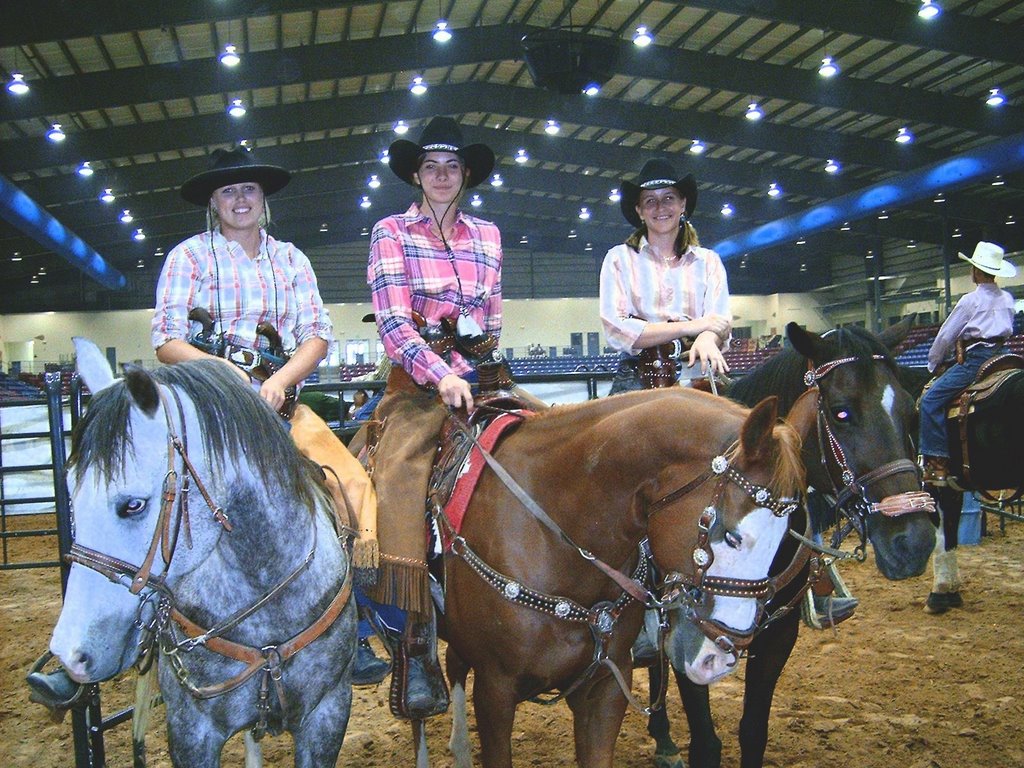
Faye Leerssen, a 14-year-old freshman from Scottsdale’s Desert Mountain High School, took the crown as Ladies Champion at the 2006 Mounted Shooters of America World Championships. Royce Anderson, of Incline NV, the seasoned veteran of many Champion titles, was Overall Men’s Champion.
Youth and experience won the day at the Mohave Crossing Arena in Bullhead AZ. Leerssen and her Paint horse “Chief” rode hard and clean to take her to the top of the sport. What’s most remarkable is that Chief required extensive surgery for an intestinal blockage in August of 2005, an operation many horses don’t survive. Not only did he survive, but with Faye’s gentle loving attention, he has returned to his fully competitive and now world champion form.
Scottsdale riding instructor Mariette Kort comments of her student, “Faye has gained so much self confidence in this sport. She is totally dedicated and has worked hard to achieve her goal.” Kort has been training Leerssen since the age of 6. She started learning the sport of mounted shooting when she was about 9-years-old.
The sport of mounted shooting combines top equestrian skills of riding with lead changes, rating a horse to the speed needed, making tight turns around barrels, and being able to strategize the best route within a course’s requirements based the horses ability; all of this while shooting a single action six gun loaded with a special black powder blank that breaks a balloon at about 10 to 15 feet. Only 5 chambers in the gun are loaded and competitors are required to shoot the first five targets in a pattern, change guns to engage the second five targets. This is an art in itself. Try holstering a gun at a full gallop and pulling another gun as you lead your horse around a barrel. It’s tougher than it looks and those balloons come up fast as you gallop the rundown towards the timer. It requires a combination of top equestrian skill and precision shooting. Top competitors can turn in times of 11 seconds!
To win a World Championship title requires years of experience and skill. And it requires a really fast and well-trained horse. “Faye is the only one to ever ride Chief. She has done all of the training herself,” says Kort. This is unusual as many top competitors often send their horses to the experts for fine-tuning. “Everyday after school and all weekend long Faye is out riding and working with Chief.”
Faye says, ”From the first time I rode Chief at Festival of the West almost 4-years-ago, I knew he was special. When we got him everyone was worried that he was too young and that I was too young to handle him. TC (MSA President TC Thorstenson) said if I could handle my crazy pony, I could handle anything.”
“Chief has been one of the most important things in my life,” comments the new World Champion. “I ride almost every day. My room is covered with pictures of Chief, my school notebook has pictures of Chief, everything I do centers around him,”
Leslie and Keith Leerssen, Scottsdale business owners, are all smiles when it comes to their daughter’s accomplishments. Bringing horses into their daughter’s life has been a blessing that has turned a shy girl into a strong and confident young woman.
###
The 2nd Annual Zoo Walk / 5K Run for Autism at the Phoenix Zoo
The 2nd Annual Zoo Walk / 5K Run for Autism at the Phoenix Zoo is a fundraiser for Autism Research. The event is Saturday October 21, 2006, registration 6:30am or register online at www.zoowalk.org. A $50 tax-deductible donation gets you a t-shirt, a wristband for all day admission to the zoo and participation in the 8am 1.1mile walk on an easy paved path, with shade and places to stop and view the animals. It’s ideal for strollers, wheelchairs and wagons, but no bikes, skateboards, or roller blades.
Runners entry fee is $25 and the run starts at 7am. The 5K run makes 2.5 loops inside the zoo.
Autism now affects 1 in 166 children. Based on government statistics, autism is growing at a startling rate of 10%-17% per year. At this rate, the ASA estimates that the prevalence of autism could reach 4 million Americans in the next decade.
Autism is a complex developmental disability that affects an individual in the areas of social interaction and communication. It’s a spectrum disorder that affects each individual differently and to varying degrees of severity. Research is needed to find effective treatments to help children and adults with Autism/Asperger’s.
Fifty percent of the Zoo Walk funds will go directly to the Autism/Asperger’s Research Program at ASU, lead by James B. Adams, Ph.D. Adams is a pioneer in the search for new treatments for children and adults with Autism and Asperger’s. In addition to carrying out important research studies, he has also organized major autism conferences in Arizona to educate families about biomedical, behavioral, and educational therapies.
The other fifty percent will go to Autism Research Institute, directed by Bernard Rimland, PhD, father of a son with autism. In 1964, he wrote the book “Infantile Autism”. In 1967, he founded the Autism Research Institute, which has gathered data on treatments from over 40,000 families, and provided information on effective treatments to over 100,000 families. In 1995, Dr. Rimland founded Defeat Autism Now!, training parents in biomedical treatments based on scientific research, physician experience, and parent input.
Phoenix Zoo is located at 455 N. Galvin Parkway in Papago Park in Phoenix.
Saturday, October 07, 2006
2nd Annual Wild Western Festival Pioneer Living History Museum
The 2nd Annual Wild Western Festival came to Pioneer Living History Museum in North Phoenix at Pioneer Road and I-17 on Saturday and Sunday, September 23rd-24th. Thousands of western lifestyle enthusiasts came out to enjoy the beautiful fall Arizona weather and plenty of cowboy shootin’, hootin’ and hollarin’, cowboy music and good eats.
DR “Buck” Montgomery bills his event as “Where History meets Hollywood”. Stars of the old westerns including Whitey Hughes, Donna Martell, Peter Brown, Don Collier, Gregg Palmer, Bob Hoy, Marie Harmon, and authors Cheryl Rogers-Barnett and Charlie LeSueur were on hand to sign autographs.
One man from Wittman says he came in to see some of his favorite entertainers from the golden age of the silver screen. “It was a time when the western reigned and the cowboy code was the way we lived.” Donna Martel commented, “It was a simpler time.” Marie Harmon reminisced about all of the stars she had worked with, “So many are gone now.”
From the moment you entered the old west town, musicians greeted you with old west ballads. A mix of modern vendor booths selling everything from resort hotel vacations to guided desert excursions for tourist and beachfront properties in Mexico, stood next to the old west merchants with cowboy hats and sheriff stars for the kids. The big barbeque pit had burgers, dogs, ribs and chicken smelling mighty good. Traditional festival fare like snow cones and kettlekorn were doing a steady business too.
Decked out in classic cowgirl fringed riding skirt and shirt Pistol Packin’ Paula entertained a good-sized audience seated comfortably on the lawn. Her rope tricks, gun spinning and whip cracking had the crowds oohing and aaahing throughout her performance. After, she took time to sign autographs and pose for pictures with fans.
Sourdough Slim and Dave Bourne took the stage at noon with a duet of piano and song. Bourne, known as the piano player in the HBO hit series “Deadwood” where his music is used as background in the Gem Saloon, showed his historian expertise as he told stories about each of the songs he played. Some were familiar, but most never made the top 40 list of hits, even back in 1880.
A nice group of award winning traditional cowboy musicians were on hand playing at one of three stages throughout the weekend. Paula Strong and Walt Richards were Western Music Association Best Duo Harmony of the Year in 2005, Tom Hiatt and the Sundown Riders, known as an Arizona Cowboy Balladeer, and Bill Barwick, “voice of the Western Channel” sang and told stories of the old west.
The World Champion Moontee Sinquah Indian Dancers and Flute player added to the traditional western flavor of the event.
Most popular were the gunfights in the old west town with Kowboy Kal, Joey Dillon, Gary “Bad Dog” Bennett, DR “Buck” Montgomery, and Pioneer’s stunt cowboys shooting it out. Crowds gathered early for seats in the grandstand or to stake out a place along the fence to catch the action up close. These gunfighters used more humor than fear in their act and the crowds enjoyed their antics.
All in all, it was a very worthwhile and entertaining festival of old west fun. A bit of advice if you attend next year, wear a hat. Even with the cooler temperatures, the sun was intense with little opportunity for shade. And drink plenty of water.
###
Arizona Heart Transplant Uses New Pump
Can you image being strong and healthy, then one day and waking up with a little cough that turns out to be an infection that causes congestive heart failure? That’s what happened to Ruben Delgadillo, 41, of Yuma, Arizona. It changed everything four years ago, setting him up for the battle for his life.
“Before, I would be out playing baseball or bowling. I was a pretty strong guy,” comments Delgadillo, a Produce Manager for Food City in Yuma. “Then my heart got this infection and for four years it got worse. A few months ago I collapsed at work and have been in the hospital since.”
Delgadillo’s heart was failing fast and measures to keep his heart pumping were not enough. He was barely surviving on less than 10% flow of blood. “The doctor at Good Sam referred me to doctors at Mayo Clinic and that’s where they asked me if I wanted to go on this new pump. It was my best option.”
He became the state's first resident to receive the new technology, HeartMate II®, a battery powered pump implanted in his chest, to maintain a steady flow of oxygenated blood until heart transplant surgery could be performed. The pump gave him a normal blood flow, which allowed him to regain strength prior to the heart transplant.
“I started feeling better right away. There’s just a wire coming out of my side to a battery or electric outlet. It didn’t make any sound unless you listened with a stethoscope and then you hear a whirring sound,” he says with a grin. They were just about to release him from the hospital two weeks after the HeartMate II® was implanted, when the call came, they had his new heart on the way.
The transplant surgery August 12th (Scottsdale Mayo Clinic’s 14th since establishing the program last year) went well and only 5 weeks later Ruben Delgadillo is up and around. “I feel great!” he says. “The swelling has gone down and the natural color is returning to my face and legs. The only pain is where the incision is healing. It’s a little tender.”
This weekend he is feeling up to a family reunion in Yuma. “My brothers and sister and Mom will all be there. It will be good to see everyone,” he says with a big smile.
“I feel pretty good. I think I am healing ahead of schedule because I was so strong before. I start physical therapy next week and I’m looking forward to getting stronger.”
“The doctors at Mayo Clinic are the greatest. I was in three hospitals and the Mayo was the best. The doctors came to see me several times a day and were calling all the time to check on me.” But ask him about the food and he emphatically says, ”It was terrible! They gave me these little tiny pancakes. I lost 85 pounds!” He continues to lose weight as the heart healthy low sodium diet continues at home. “My sister Eva watches me real close to be sure I eat right.”
Taking care of his new heart and working toward returning to his life are his full time job for now. “It’s just good to be up and around again. I feel pretty good.”
Tramanto Neighborhood Watch
Tramanto citizens, in conjunction with Phoenix police, are launching a new crime prevention effort to include volunteer patrols and Neighborhood Watch signs.
Christian Wittenberg recalls his neighbor going outside carrying a baseball bat to investigate a “would be car thief” and getting shot in the foot. It’s a rare occurrence in Tramanto and one that the PNP (Phoenix Neighborhood Patrol) would like to prevent.
With grant funds of $4700 the PNP is installing 50 Neighborhood Watch signs 24”x18” that read “Warning: This area protected by neighborhood watch and Operation ID. To report suspicious activity call Crime Stop at 602-262-6151. Take a bite out of crime. A picture of McGruff, the “crime fighting dog” completes the sign. Reports indicate these signs are effective in warning criminals they will be watched and are likely to avoid the area. The grant funds also pay for patrol mileage, uniforms, cell phones, flashlights, and office supplies.
Seven volunteers have gone through a full day of training with the Phoenix Police department. The all day Saturday class educates recruits about what they can and can not do as civilians on patrol. Subjects like graffiti, recognizing suspicious activity and patrol guidelines are discussed. Recruits must be over 18-years of age and pass a background check and have no felony arrests on record. There is no pay, just a willingness to protect the community.
“I learned a lot of things in the class. Like you can not grab someone and detain them against their will,” says Wittenberg. “We just have to call the police to apprehend the suspects. We don’t carry guns as part of our agreement with the Phoenix police department. The training teaches our patrol how to safely handle a situation until the police arrive. Basically, we are there to observe and report to the police.”
Wittenberg is retired and the only full time PNP worker. All of the other volunteers work full time jobs and do their patrols on weekends and evenings. “Right now we get two patrols a month,” Wittenberg says. “I wish we had more volunteers. We would like to get more frequent patrols.”
“One way citizens can help the PNP is to keep cars off the street overnight,” Wittenberg says. “Any car on the street overnight is suspicious. Also emergency vehicles can not get through if cars are parked on the streets.”
Tramanto is one of the safest communities in Phoenix with very low crime statistics. Wittenberg and his PNP force intend to keep it that way.
Subscribe to:
Posts (Atom)